

Insight

The Hike That Answered One Question and Raised Three More
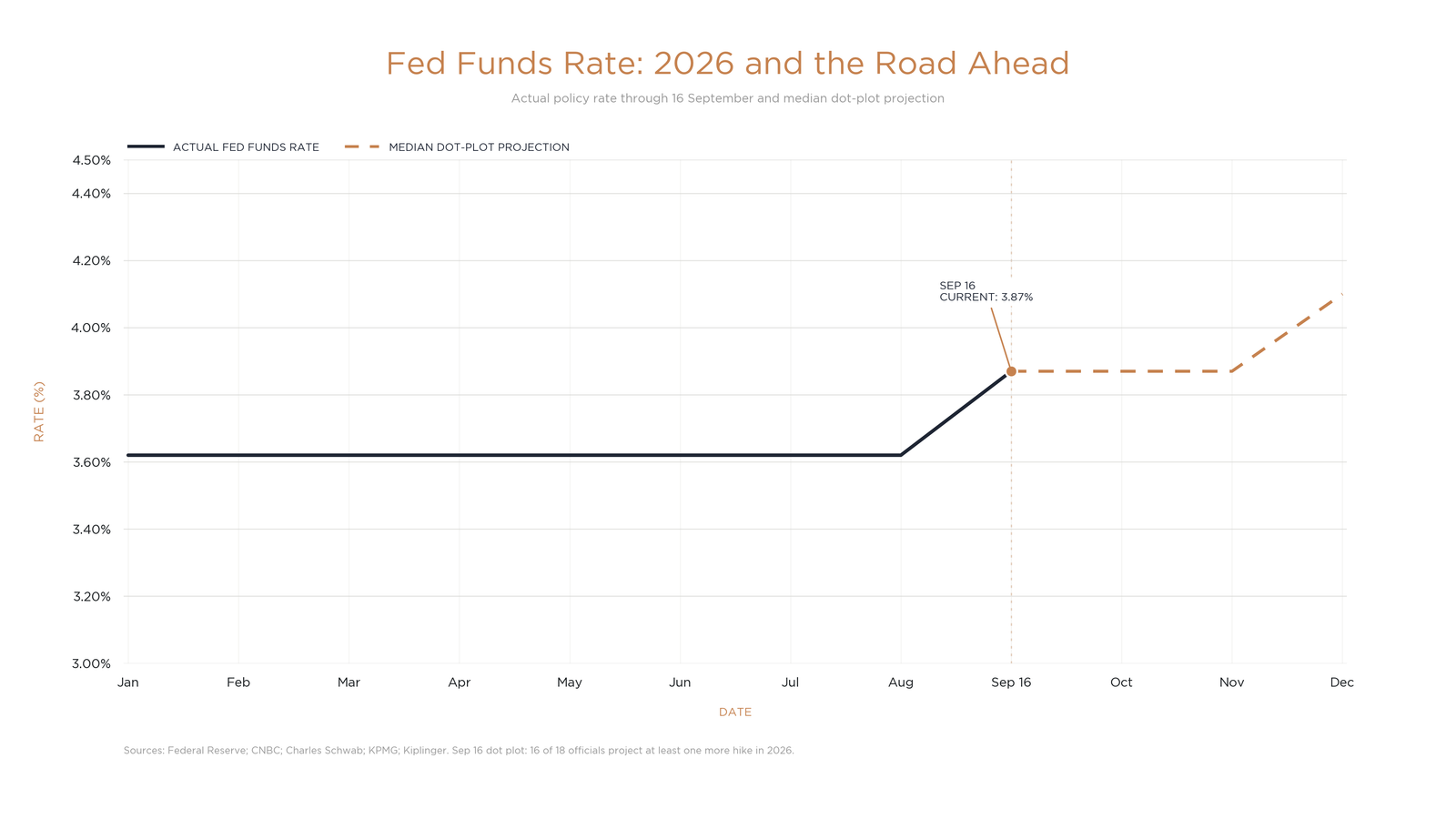
On 16 September 2026, the Federal Reserve raised interest rates for the first time since July 2023. The vote was 12–0. The move was universally expected. And yet the market didn’t know quite what to do with it.
The S&P 500 fell sharply on the day, then recovered the following morning. Bond yields surged to their highest levels in almost two decades. Gold held near $4,270 rather than collapsing, resisting the conventional script for a metal caught between rising real yields and dollar strength. Oil stayed above $100 per barrel, the mechanism that made the hike necessary in the first place.
September 2026 will be remembered as the month markets were forced to answer a question they had been avoiding all year: is this 2022 again, a tightening cycle that ends in recession and a bear market, or is it something different? The answer matters enormously for how the final quarter of the year is positioned.
Oil: The Variable That Is Driving Everything Else
The most important chart in September 2026 is not the Fed funds rate. It is the Brent crude oil price.
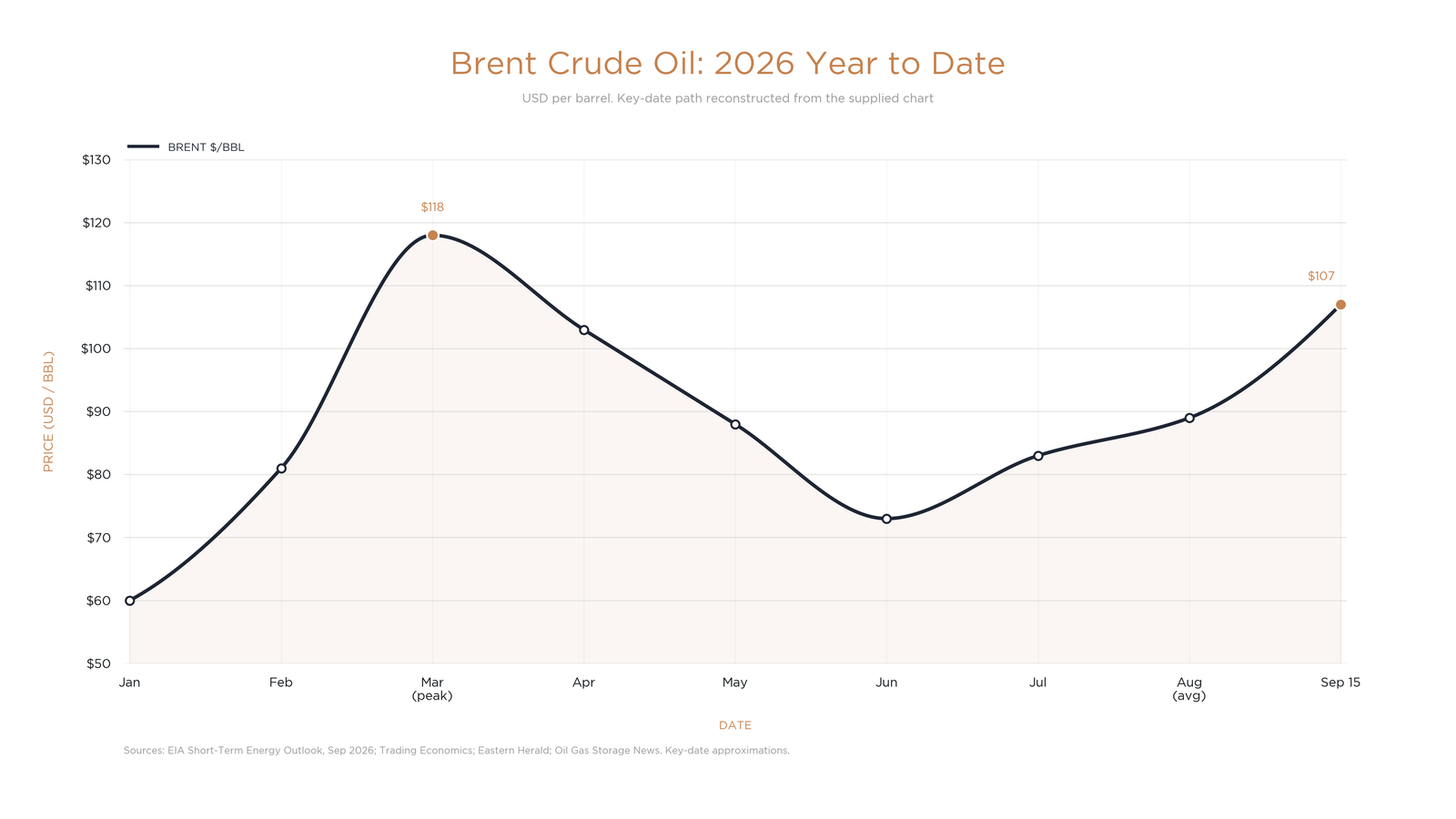
From a low of $61 at the start of the year, Brent surged to $118 at the peak of the Hormuz closure in March, retreated to $74 in July on ceasefire optimism, then climbed back above $107 by mid-September as renewed hostilities made clear the diplomatic window had closed without a deal. The EIA’s September Short-Term Energy Outlook estimated crude oil production shut-ins at 6.7 million barrels per day in August, up from 5.0 million in July, with the Strait of Hormuz and Bab el-Mandeb both remaining constrained and variable.
Why This Matters Beyond Energy
The critical insight: the Federal Reserve cannot control the price of oil. It can only respond to what oil does to inflation. As long as Brent stays above $90, the inflationary pressure that forced September’s hike does not meaningfully abate. That is the mechanism connecting every asset class in September 2026.
Hormuz throughput has collapsed from 21.6 million barrels per day before the conflict to approximately 4.9 million, representing a 77% reduction. The Saudi East-West pipeline has been restored to around 3.5 million barrels per day via repairs, but that provides only partial bypass. Independent ship-tracking data shows daily transits at roughly 12 to 13% of the pre-war baseline. The strait is not closed. It is compromised, which may be a harder problem to solve than a full closure.
The Fed: A Hike That Was Inevitable, a Path That Is Not
The September 16 decision itself was the least surprising element of the month. What mattered was everything that surrounded it.
What the FOMC Did
What Warsh Said
“We removed a dose of accommodation so that financial and credit conditions would be more consistent with our ultimate objectives.”, said Chair Kevin Warsh on September 16, 2026.
The phrase “removed a dose of accommodation” is the most important line in the statement. It signals that Warsh does not consider the current rate level to be restrictive, but only less accommodative. That distinction matters because it implies further tightening may be justified on the same logic even without a deterioration in inflation data.
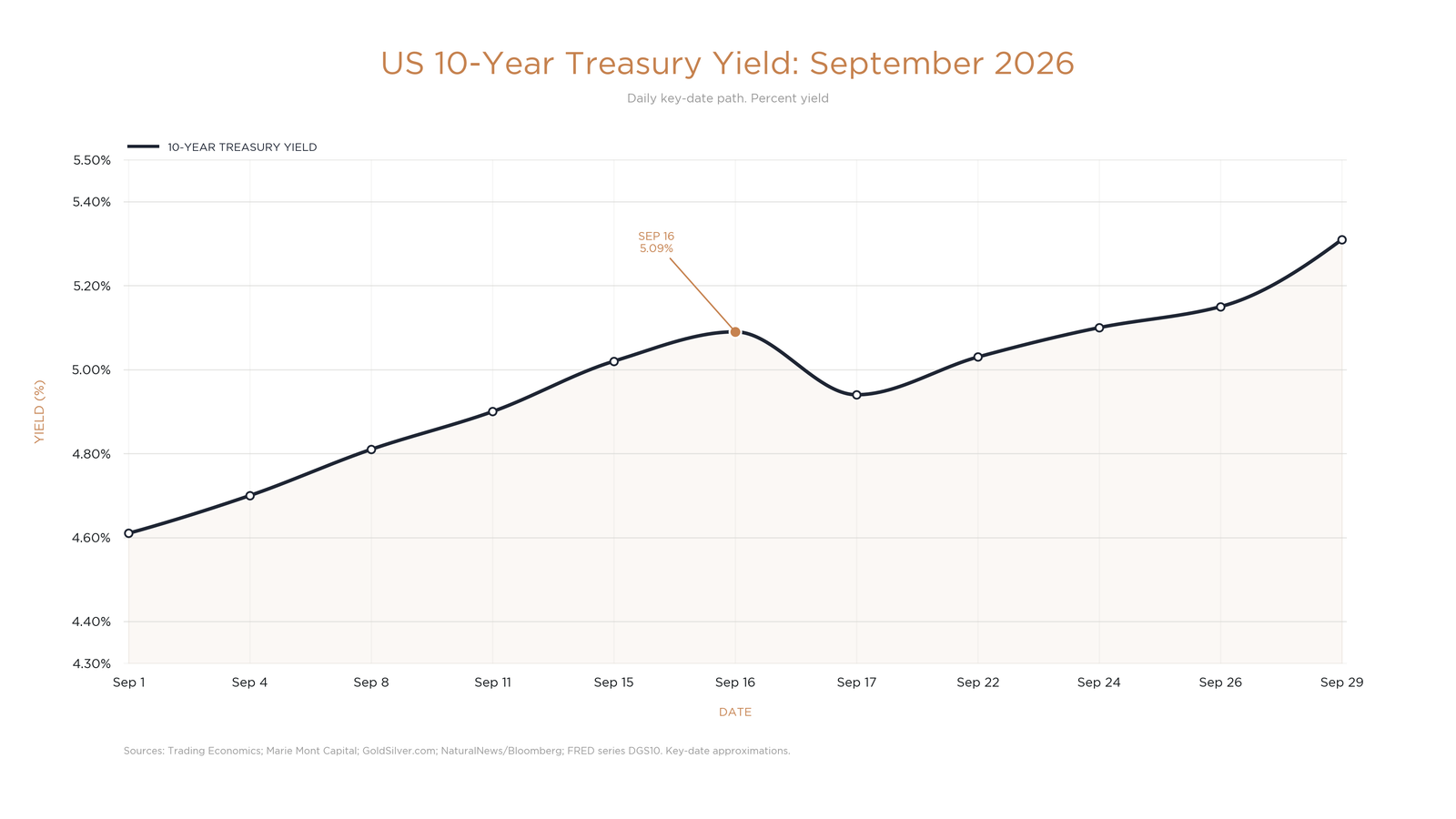
The bond market heard it clearly. The 10-year Treasury yield, which entered September at 4.62%, rose to 5.02% on 15 September (its highest since 2007) and continued climbing to 5.28% by month-end, up 46 basis points in September alone. The 30-year yield hit a five-year closing high of 5.49%.
Déjà Vu? The 2022 Comparison
The instinctive comparison is 2022: oil-driven inflation, an aggressive Fed, rising yields, falling equities. That comparison is understandable but incomplete.
The difference: a tightening cycle into a strong economy and strong earnings is not the same event as a tightening cycle into a weakening one. History is consistent on this point. The S&P 500 averaged 23.7% in the 12 months following the end of the previous six rate hike cycles since 1988. The question is not whether this cycle ends, as it eventually will, but whether the economy can sustain itself until it does.
The Bond Market: When Yields Tell You More Than the Fed Does
September 2026 produced the most significant move in the US Treasury market in over a decade. The 10-year yield rising 46 basis points in a single month is not routine. It is a signal.
What Drove the Move
What the Bond Market Is Actually Saying
The 10-year yield at 5.28% is not just a rate level. It is a statement about duration. A market that sends the 30-year yield to a five-year high of 5.49% is pricing a world in which inflation does not return to target quickly and the Fed remains in a tightening posture for an extended period.
For investors, this creates an unusual opportunity. A 10-year Treasury at 5.28% offers the highest real yield since the pre-financial crisis era. The decision to own bonds is no longer the question of opportunity cost it was in 2021. At these levels, high-quality fixed income is genuinely competitive with equities on a risk-adjusted basis for the first time in fifteen years. Investment-grade credit issuance in September was on track to exceed $200 billion, setting a monthly record, as corporates rushed to lock in long-term financing before yields moved higher. High yield issuance reached $38.5 billion, marking the busiest month of 2026. The market is functioning; credit is available; the economy is borrowing. These are not the conditions that precede a credit crisis.
Gold: The Metal That Refused to Follow the Script
Gold entered September at $4,451 per ounce, having pulled back from August’s high of $4,710 following Jackson Hole. What happened next was one of the more interesting episodes in recent commodity market history.
As the 10-year Treasury yield climbed from 4.62% to 5.28%, a move that in any conventional model should have devastated the non-yielding metal, gold fell only to $4,271. It then recovered to $4,350 the day after the hike, fell again as Warsh’s press conference proved hawkish, and settled near $4,278 by late September. A 4% decline against a 46 basis-point yield spike is not capitulation. It is resilience.
Why Gold Didn’t Fall Further
The structural thesis for gold in 2026 is unchanged: $37 trillion in U.S. federal debt, $1 trillion in annual interest payments, and a dollar losing reserve share over two decades. What has changed is the near-term horizon. With the 10-year at 5.28% and a December hike being actively priced, gold faces real yield headwinds until the tightening cycle peaks. That peak, whenever it arrives, is historically one of the most powerful positive catalysts for the metal.
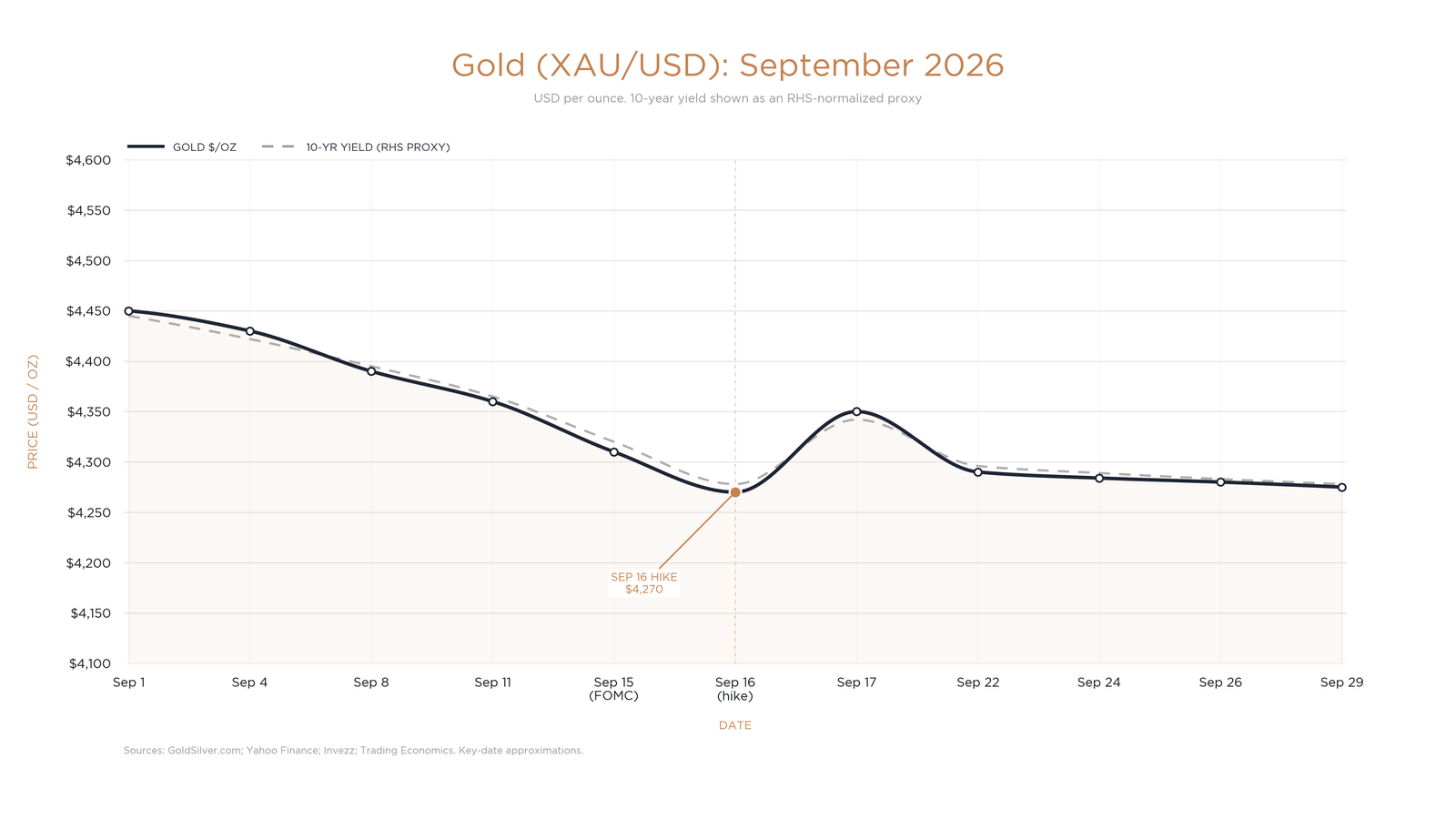
Current analyst targets: Goldman Sachs $4,900 year-end, J.P. Morgan $4,500 for Q4, Bank of America $4,360. All three remain above current prices of approximately $4,278. The 4,200–4,300 range, where gold has demonstrated structural support in September, represents the accumulation zone that long-term positioning frameworks point toward.
The defining question for Q4 2026 is whether the second inflation cycle, which is the oil-driven re-acceleration that followed the brief June disinflation, peaks here or extends. The answer determines whether September 16 was the cycle’s last hike or its penultimate one.
The defining question for Q4 2026 is whether the second inflation cycle — the oil-driven re-acceleration that followed the brief June disinflation — peaks here or extends. The answer determines whether September 16 was the cycle’s last hike or its penultimate one.
The defining question for Q4 2026 is whether the second inflation cycle, specifically the oil-driven re-acceleration that followed the brief June disinflation, peaks here or extends. The answer determines whether September 16 was the cycle’s last hike or its penultimate one.
1. Equities: Strong Earnings Beat the Rate Noise
The S&P 500 closed September at 7,657, which is 1.8% below its August record high of 7,817. For a month that included the first Fed hike in three years, a 10-year yield at 19-year highs, and oil above $100, that is not a collapse. It is consolidation.
Action: maintain diversified equity exposure, avoid reducing positions solely on rate anxiety. The earnings foundation is the stabilising force.
2. Fixed Income: The Most Interesting in Fifteen Years
A 10-year Treasury at 5.28% and a 30-year at 5.49% represent a fundamentally changed fixed income landscape. For the first time since the pre-financial crisis era, government bonds offer a genuinely competitive risk-adjusted return.
3. Real Assets: The Inflation Hedge That Is Earning Its Place
Oil at 90–107, gasoline at record levels, and CPI stuck at 3.4% make the case for real asset exposure clearer in September than at any point in the year. The Hormuz constraint is structural: EIA projects shut-ins averaging 5.7 million barrels per day through Q4 2026.
4. Gold: Hold Through the Yield Peak
The near-term picture for gold is straightforward: every additional hike, every basis point the 10-year climbs, creates incremental short-term pressure. The appropriate posture is to hold existing positions through the rate cycle peak and add on pullbacks toward 4,200–4,300. The structural case (including central bank accumulation, dollar reserve diversification, and sovereign debt sustainability concerns) does not resolve until the tightening cycle ends. When it does, the positive impulse for gold will be proportional to how far yields fall from their five-year highs.
5. The Midterm Election: The Overlooked Stabiliser
November 3 is six weeks away. The administration’s incentive to see lower energy prices, a calmer market, and sustained economic growth into election day is not a minor consideration. It is one of the most powerful near-term political stabilisers in the current environment.
Final Thought
Déjà vu implies the same story playing out twice. But the 2022 parallel only holds if the economy behaves as it did then: earnings falling, consumers retreating, and credit tightening. None of those conditions are present today.
What September 2026 actually resembles is a market being asked to price a genuine ambiguity: an economy strong enough to keep hiking into, and a supply shock persistent enough to require it. That is uncomfortable. It is also, for investors with the structure to hold through the discomfort, precisely the kind of environment that rewards patience.
The earnings are growing. The consumer is spending. The labour market is adding 162,000 jobs a month. The Fed is hiking, yes, but it is hiking because the economy can take it. That is a different story from 2022. And different stories have different endings.
Commentary by AIX Investment Group
Disclaimer
The above market analysis/information is produced for information and knowledge purposes only under personal capacity, and does not constitute any liability or obligation upon the readers or the firm to take investment decisions. AIX Financial Consultation LLC is regulated by the Capital Market Authority (UAE), licence number 869463. Professional investors only.
References