

Insight

July has delivered the data that markets spent the first half of the year waiting for. An inflation reading that reframed the Federal Reserve’s policy path. An earnings season running materially ahead of every meaningful expectation. And an equity market that, after months of absorbing shocks, is beginning to do what healthy markets do: reward companies with genuine earnings power.
The picture that emerges from July is not one of a market being carried by momentum or hope. It is one of fundamentals reasserting themselves. Earnings are growing, inflation is cooling, the consumer is still spending and the framework that disciplined investors have held through a volatile first half is now being validated by the data.
The Inflation Reading That Changed Everything
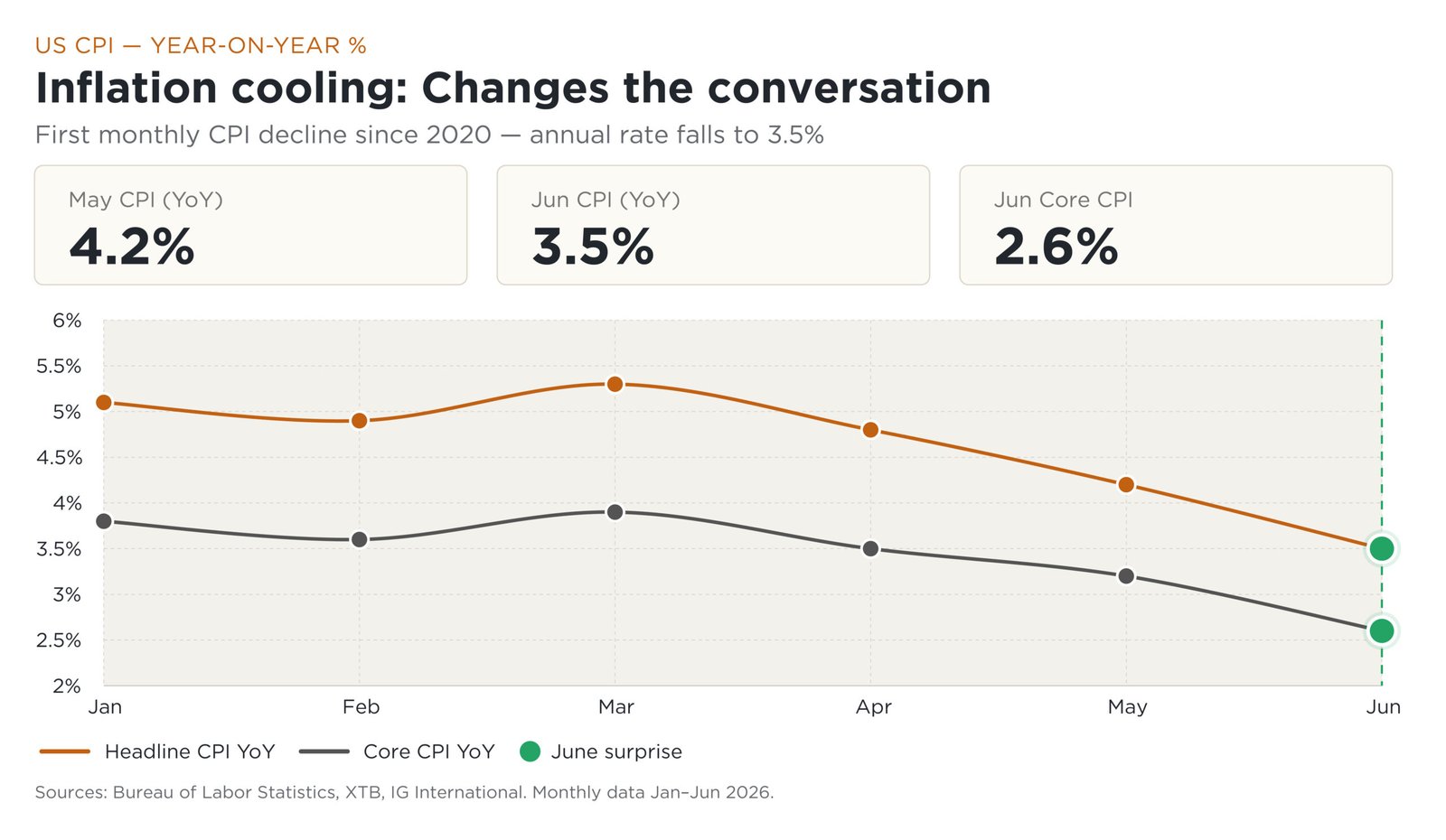
The defining macro moment of July arrived on 14 July, when the Bureau of Labor Statistics released June CPI data that surprised substantially to the downside. Headline inflation fell 0.4% month-on-month, the first monthly decline since the COVID era of 2020, pulling the annual rate to 3.5% against a consensus forecast of 3.8%. Core inflation was stripping out food and energy which came in at 2.6%, at its lowest reading in several years and well below expectations.
The mechanism was energy. The ceasefire-driven decline in Brent crude from its April peak above $100 per barrel through to the low $70s in early July fed directly through to petrol prices and goods costs. The following morning, PPI data confirmed wholesale prices down 0.3% for the month, with the Wall Street Journal describing the combined release as a broadly Goldilocks set of data points.
The market reaction was immediate. September rate hike probabilities, which had been running near 80% entering the month, fell sharply. The same inflation dynamic that had been the primary headwind for equity valuations through the spring had, in a single data release, become a tailwind. Bonds rallied. Growth stocks extended gains. The S&P 500 touched 7,575 on 10 July, its highest level of the year.
Services inflation remains elevated, with year-on-year PPI still running at 5.5%, and the consumer continues to demonstrate resilience: retail sales rose 0.9% in May and 0.2% in June, with year-on-year spending running 6.7% above prevailing inflation rates. The disinflation story is real, energy-led, and broadening.
An Equity Market Finding Its Footing
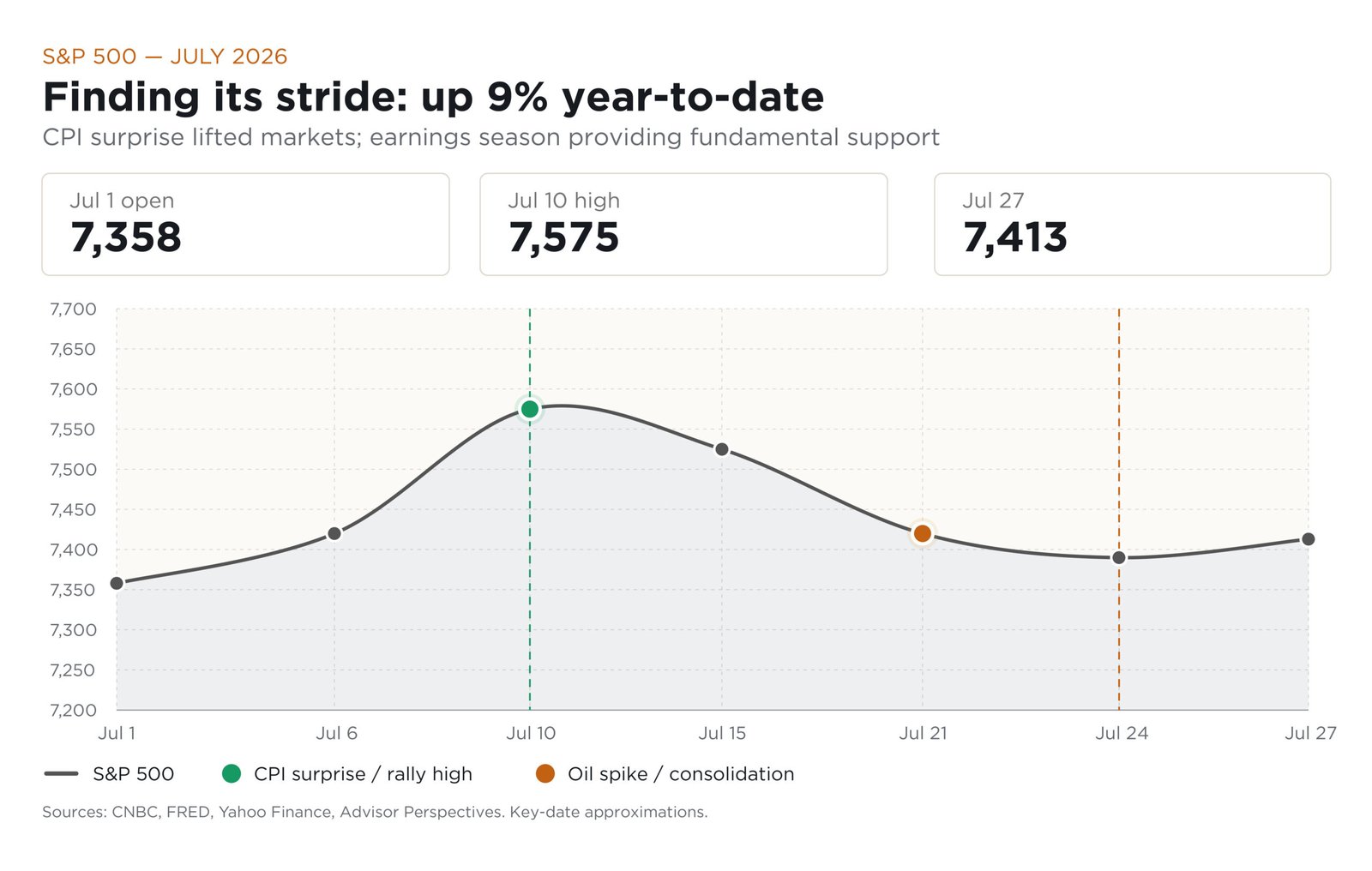
The S&P 500 opened July at 7,358, carrying the gains from June’s nine-week recovery into a month that would test them. The CPI surprise on 14 July provided the next leg: the index reached 7,575 by 10 July, building on the positive momentum ahead of the release, before consolidating as oil price volatility returned in the third week of the month. By 27 July, the index was trading at 7,413 up 9% year-to-date, and 12.2% on an equal-weighted basis.
That equal-weight outperformance is one of the most constructive signals of the year. A market where the average stock is performing better than the cap-weighted index is a market with genuine breadth rather than narrow leadership. The Russell 2000 has gained over 22% in the first six months of the year, its best first-half performance since 1991. International equities, European markets recovering on lower energy input costs, and MSCI EM – up 15.9% year-to-date have each contributed to a recovery that is broader and more durable than the concentrated momentum of the previous cycle.
The S&P 500’s modest consolidation from the 7,575 high is not a cause for concern. A market pausing to absorb strong gains ahead of the most concentrated week of earnings reporting is behaving exactly as a healthy market should. The quality of the underlying move matters more than the precise level.
Earnings Season: The Real Economy Speaking
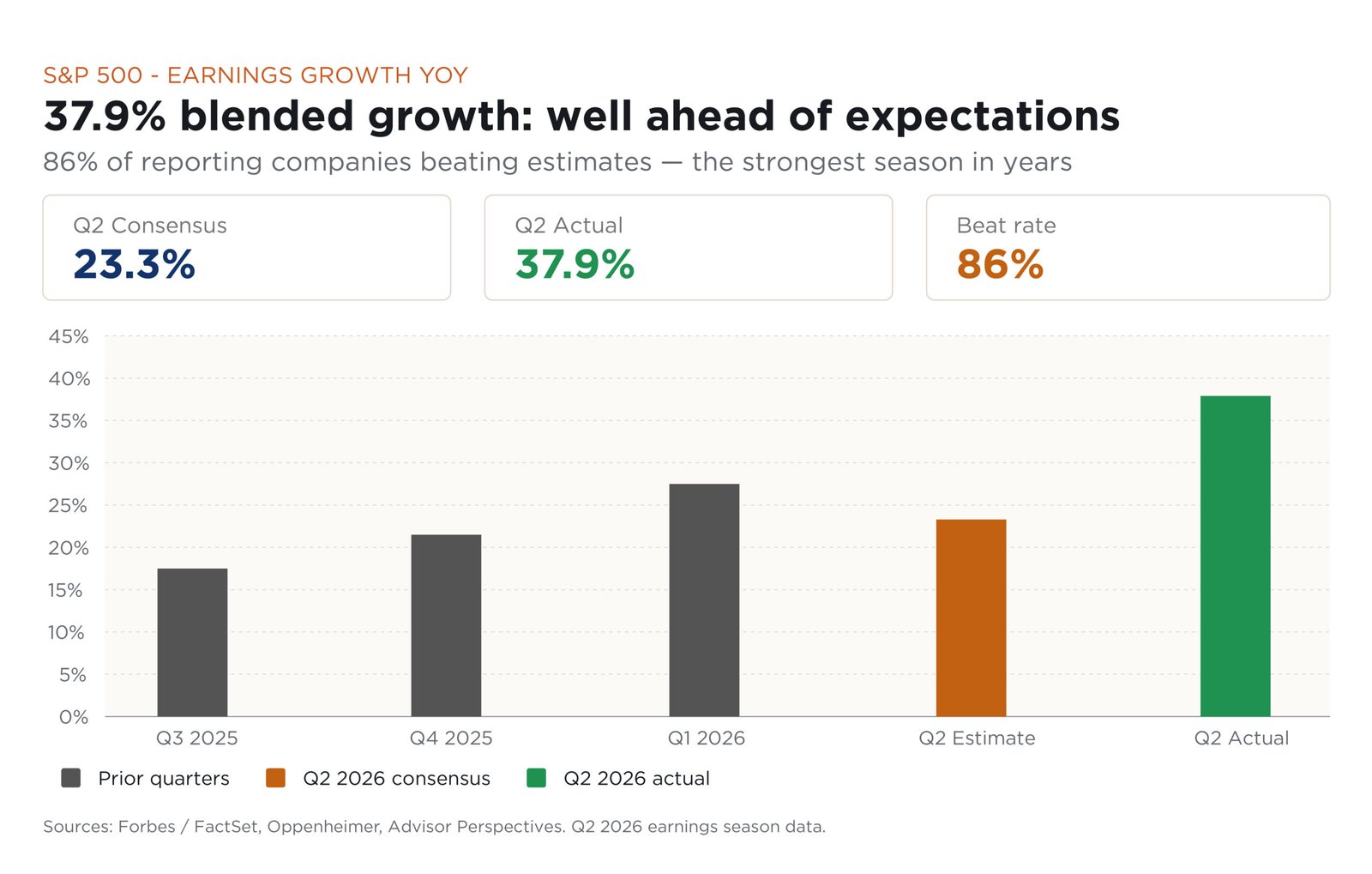
With approximately two-thirds of the S&P 500 having reported by the end of July, Q2 2026 has delivered an earnings season that few would have predicted at the start of the year. Blended earnings growth stands at 37.9% year-on-year, substantially above the 23.3% consensus estimate at the start of the quarter, and well above the 28% growth recorded in Q1. The expected growth rate for the full calendar year 2026 has been revised up to 27.3%. Eighty-six percent of reporting companies are beating estimates.
The banking sector set the tone in the first week, with JPMorgan Chase, Goldman Sachs, Bank of America, and Morgan Stanley all reporting on 14 July. Higher net interest income in a sustained elevated-rate environment, combined with strong trading revenues across volatile markets, confirmed the financial sector’s ability to generate earnings through the cycle rather than despite it.
In technology, the market is asking a more sophisticated question than it was twelve months ago. The conversation has evolved from how much are you spending on AI to what returns is that spending generating. The companies able to answer the second question clearly are being rewarded. Meta Platforms rose approximately 15% in a single week after Bank of America maintained its buy rating following evidence of meaningful improvements in AI cost structure. The week of 28 July brings the season’s most intensive reporting window: Meta, Microsoft, Amazon, and Apple alongside the Fed decision and Q2 GDP.
This is not a market being sustained by multiple expansion or liquidity. It is a market where the underlying earnings power of major businesses is expanding ahead of every reasonable expectation. That distinction is the foundation of a durable recovery.
Oil: A Volatile Month With a Constructive Conclusion
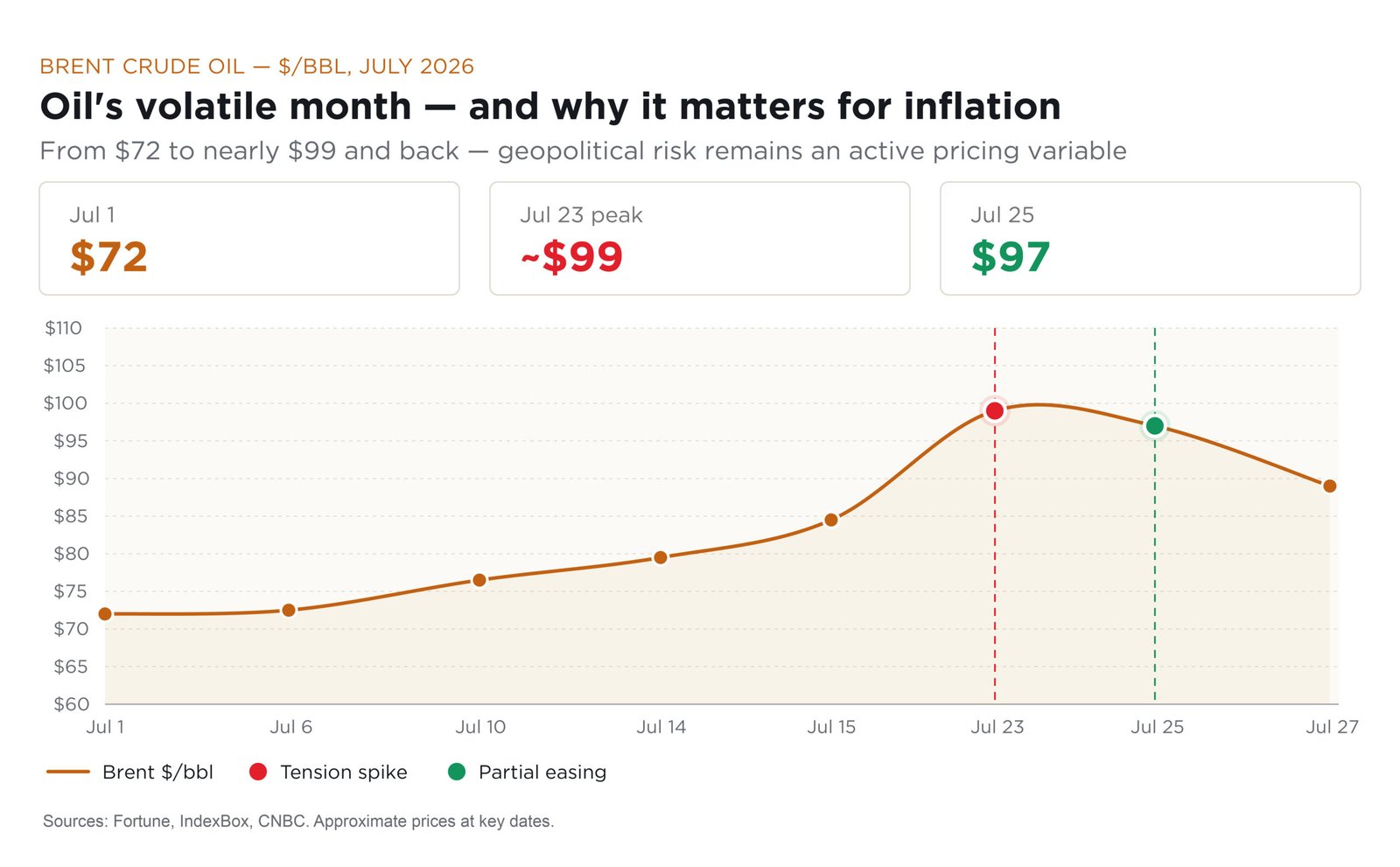
Brent crude’s July trajectory has been one of the more instructive sequences of the year. The month opened near $72 per barrel, reflecting the post-ceasefire optimism from June. By 23 July, Brent had surged to nearly $99 as renewed geopolitical tensions and reports of disruption spreading to Red Sea shipping reignited supply fears. By 25 July, prices had retreated toward $97 as diplomatic signals from Washington including a pause in hostilities and the withdrawal of a proposal to impose charges on strait cargo – helped stabilise sentiment.
The spike-and-recover pattern is instructive in both directions. It confirms that Hormuz remains an active pricing variable, not a resolved risk. But each resolution that occurs without a full breakdown of the ceasefire framework also demonstrates the resilience of the diplomatic structure underpinning the pause. U.S. domestic political incentives ahead of November’s midterm elections remain a powerful stabilising force.
The positive implication for the broader market is that oil’s partial retreat from the $99 spike has preserved much of the disinflationary tailwind that June’s CPI data established. WTI trading near $89 as of 25 July, well below the levels that drove inflation through the spring means the Fed’s September calculus remains more balanced than the oil spike alone would have suggested. Sustained containment of energy prices through August is the single most important variable for both inflation data and monetary policy entering the autumn.
The Federal Reserve and What Comes Next
The Federal Open Market Committee meets today, 28 and 29 July. Markets are pricing a hold as the base case at 3.50% to 3.75%, with Chair Warsh’s data-dependent posture giving investors reason to expect that improving inflation data will be acknowledged. September remains live at approximately 50 to 60% hike probability following oil’s mid-month spike, but that probability moves materially lower if the PCE inflation data due Thursday 30 July confirms June’s disinflationary trend.
The constructive read on this configuration is that the asymmetry favours investors. A hold in July with a moderating inflation tone is a positive surprise for markets that had priced aggressive tightening. A September hold – increasingly possible if energy stays contained and PCE cooperates – would provide a meaningful additional tailwind into the year’s final quarter. A hike, if it comes, has already been substantially priced in, limiting the downside surprise.
The framework that has served investors well through the first seven months of the year remains the right one for what comes next. Diversification across geographies and asset classes is working: equal-weight equities, international markets, and small and mid-caps are all outperforming the concentrated large-cap narrative. Income generation through fixed income and private credit continues to compound in an environment where rates remain elevated. Real assets provide a hedge against the above-target inflation that will persist even as the direction of travel improves. And liquidity the ability to act when oil spikes or earnings disappoint remains the most valuable capability an investor can hold.
July has not removed uncertainty from the investment landscape. What it has done is replace fear-driven uncertainty with data-driven clarity. The earnings are strong. The inflation trend is improving. The consumer is holding. The market is broadening. These are the conditions in which patient, structured capital compounds.
Commentary by AIX Investment Group
Disclaimer
The above market analysis/information is produced for information and knowledge purposes only under personal capacity, and does not constitute any liability or obligation upon the readers or the firm to take investment decisions. AIX Financial Consultation LLC is regulated by the Capital Market Authority (UAE), licence number 869463. Professional investors only.
References