

Insight

A Month That Threw Everything at Markets and Markets Held
October 2026 asked a great deal of investors. The Federal Reserve is in its first tightening cycle since 2023. The 10-year Treasury yield touched its highest level since 2002. Brent crude climbed to a six-month high above $116 as attacks on Saudi Arabia and Gulf shipping intensified. And an AI spending scare handed the Nasdaq its steepest one-day fall since early June.
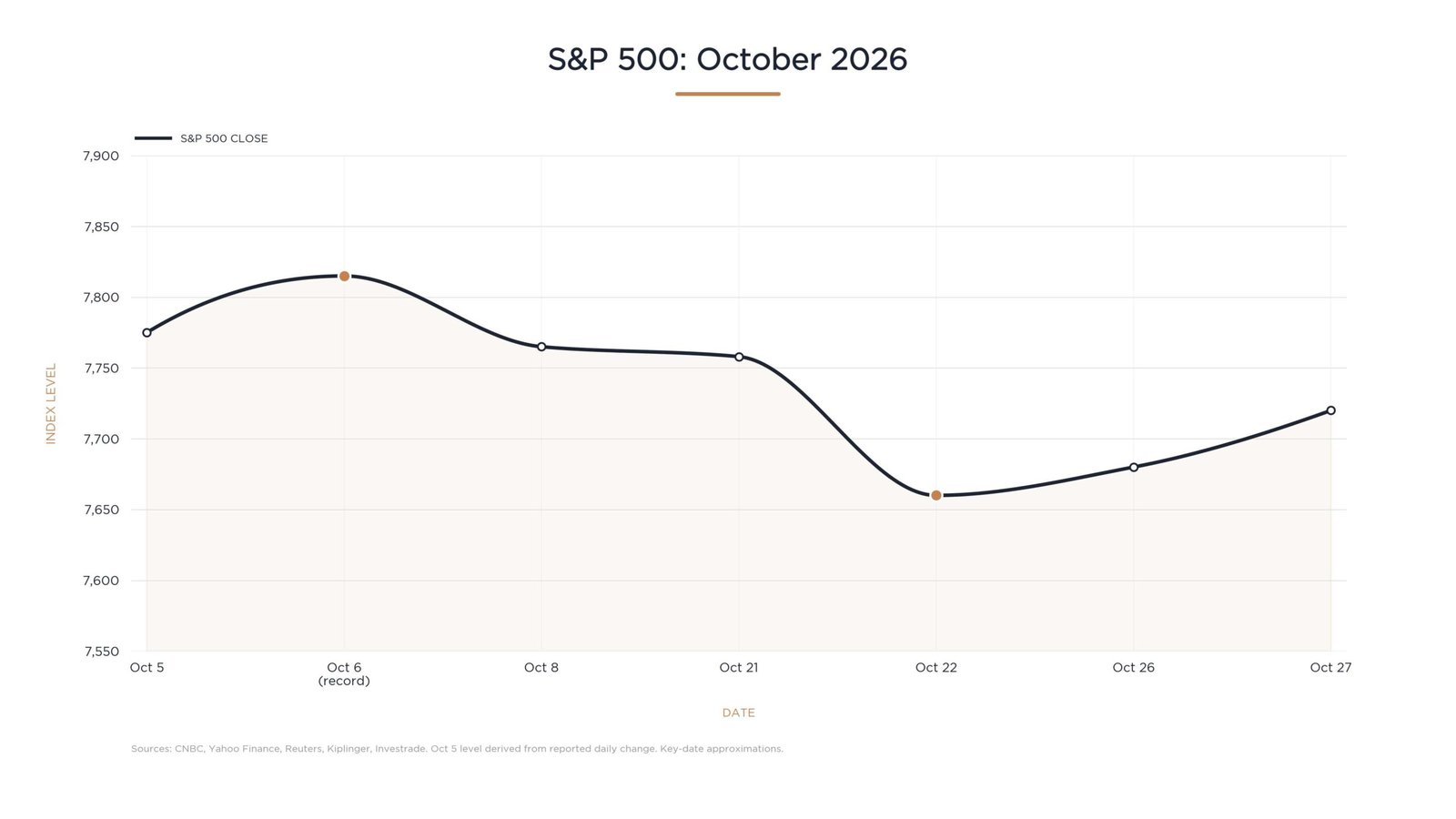
Yet the S&P 500 set a record close on 6 October, sits about 1% below it today, and is up roughly 11% for the year. Corporate earnings are growing at close to 30%. That combination is what resilience looks like, and it is the thread running through this report.
October at a Glance
Records: New Highs, Then a Healthy Breath
On 6 October the S&P 500 closed at 7,818.93, its first record since August. The Nasdaq set a record the same day as Nvidia and AMD reached new highs, with Nvidia’s market value approaching $6 trillion. The rally rested on a simple belief: that corporate America can carry higher energy costs and higher interest rates.
Then came 22 October. Meta fell about 7% after its results, as its plan to issue non-voting stock to fund AI spending revived questions about capital commitments. The Philadelphia semiconductor index dropped 6.7%, the Nasdaq lost 2.6%, and the S&P 500 fell 1.2% to 7,663.
What the Pullback Actually Showed
What this means: a selloff confined to the most crowded trade, absorbed without damage to the broader index, is what a healthy and broadening market looks like. The caveat is concentration. More than half of this quarter’s S&P 500 earnings growth is expected to come from AI infrastructure, which is why diversification matters more than any single theme.
Rates: Yields Touched 5% and Income Is Back in the Conversation
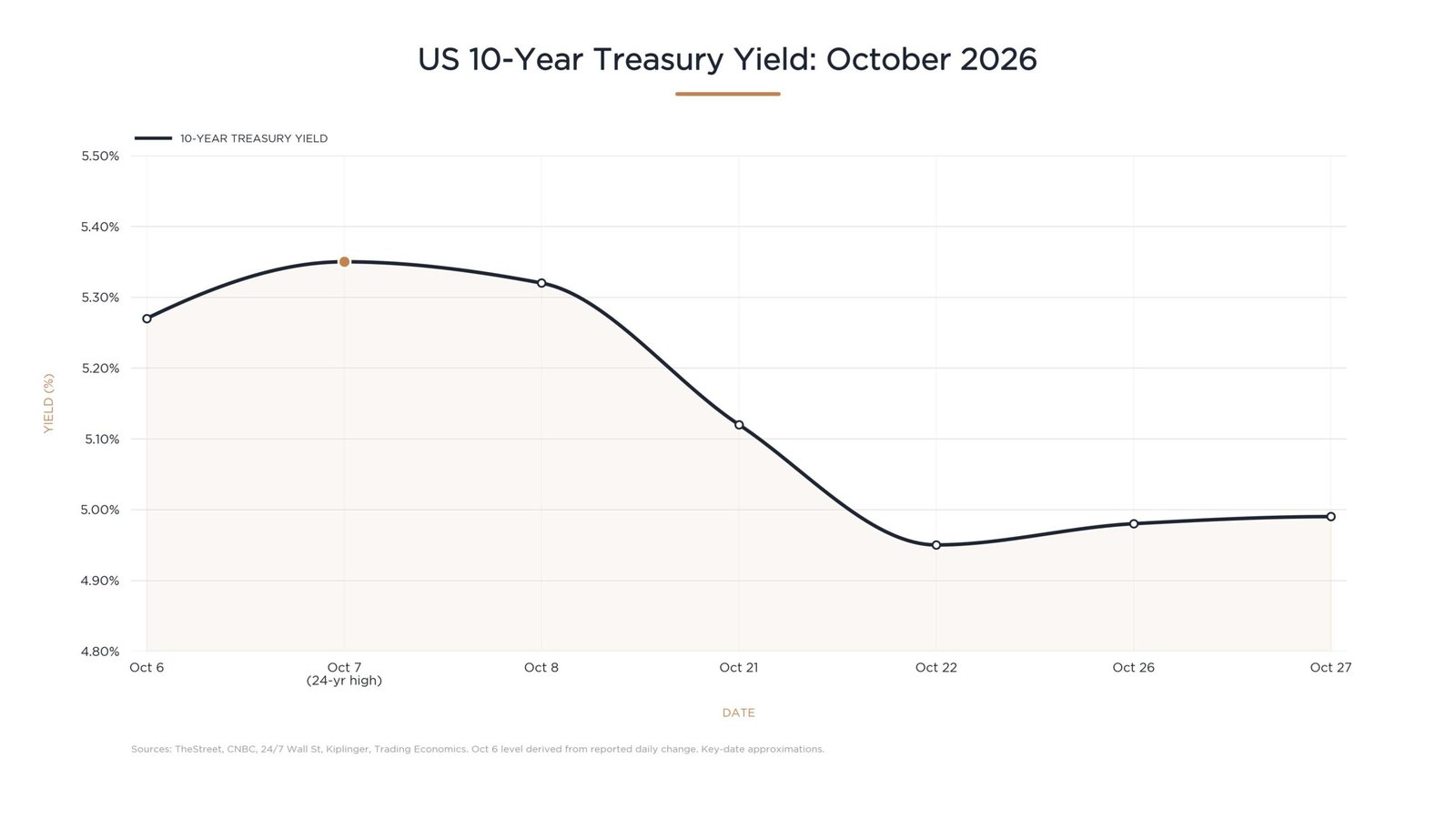
The 10-year Treasury yield reached 5.35% on 7 October, its highest since 2002, while the 30-year touched a 24-year high near 5.72%. September CPI explains much of it. Headline inflation rose 0.6% on the month to 3.7% year-on-year, with gasoline up 9.1% in a single month. Core inflation, which strips out food and energy, was 2.6%.
Then the move reversed. On 22 October the 10-year yield fell about 19 basis points to roughly 4.95%, its biggest one-day decline in more than two years and its first close below 5% since 22 September.
Where the Fed Stands
“Dario Perkins of TS Lombard expects the Fed “will need to keep hiking until its target is in sight.”
What this means: with core inflation at 2.6% against a headline of 3.7%, the pressure is energy-led, and energy is the variable most likely to ease if diplomacy advances. For investors the opportunity is already here. A 10-year Treasury near 5% offers a meaningfully positive real yield for the first time since before the financial crisis, and income has become a genuine source of return rather than a defensive afterthought.
Resilience: Earnings Are Doing the Heavy Lifting
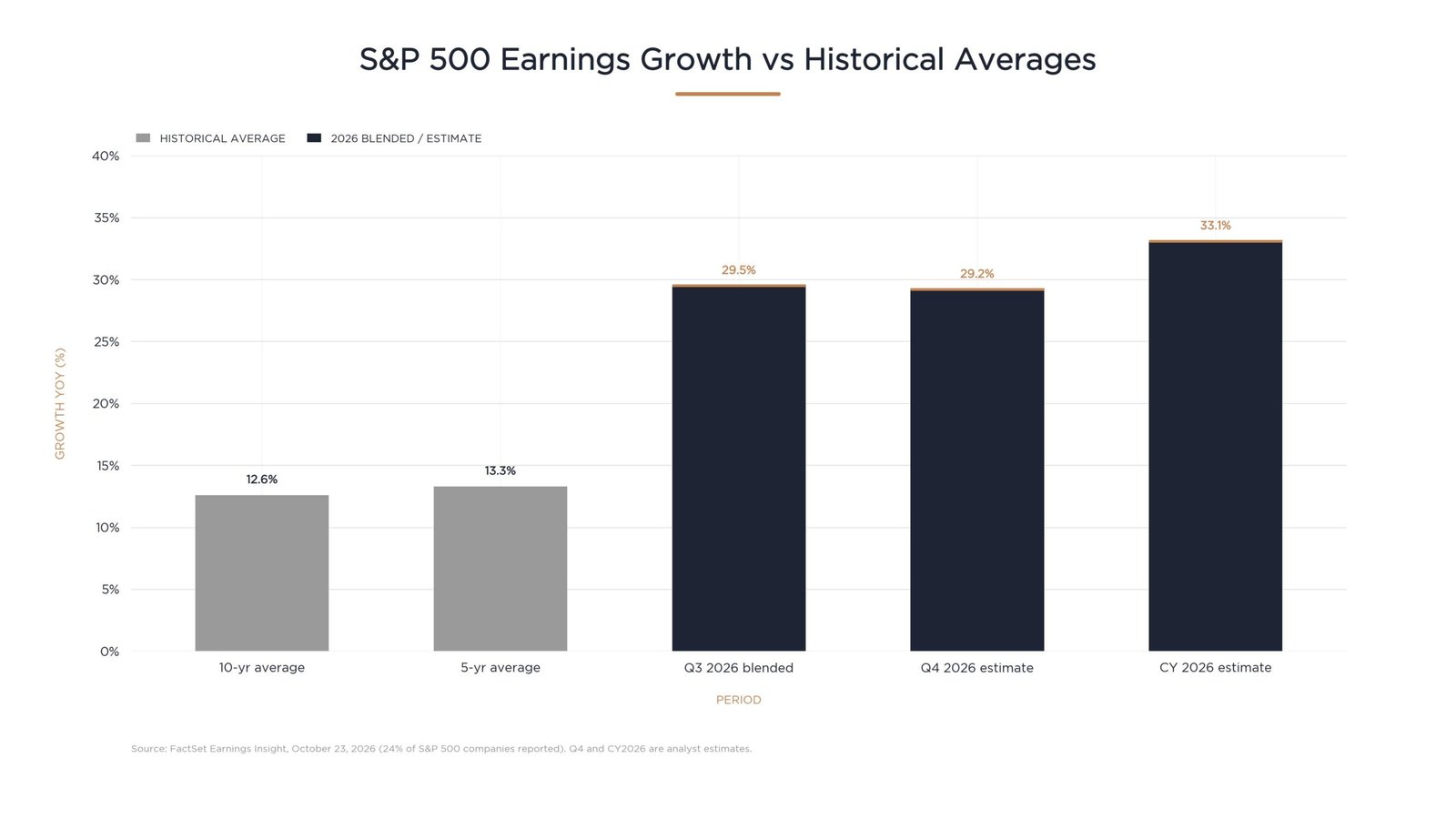
With 24% of S&P 500 companies reported as of 23 October, blended Q3 earnings growth stands at 29.5% on revenue growth of 12.7%. If it holds, it will be the third consecutive quarter above 25% and the eighth straight quarter of double-digit growth.
The Honest Fine Print
What this means: earnings are the shock absorber. With yields at 5%, oil at $116 and the AI trade stumbling, the S&P 500 stayed near its record because profits kept compounding.
Oil: A Shock the Market Has Learned to Carry
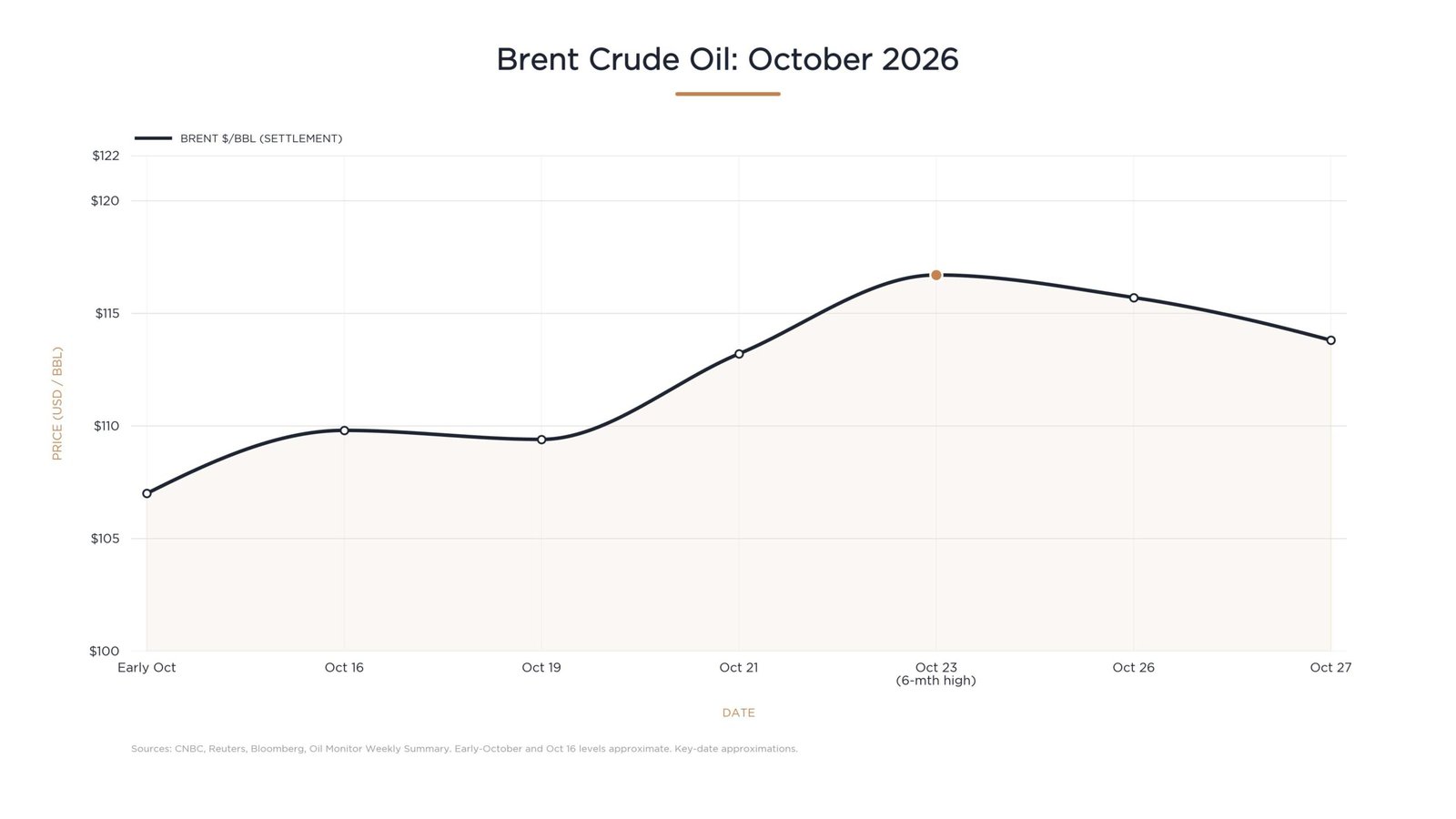
Brent settled at $116.72 on 23 October, the highest close since 29 April and a third straight weekly gain. Houthi attacks targeted Saudi sites including Yanbu and the Shaybah oilfield, and October saw 28 attacks on commercial vessels around the Strait of Hormuz, the most in any month since tracking began in 2017. US Strategic Petroleum Reserve stocks have fallen to 282.6 million barrels, the lowest since October 1982.
Yet the market is increasingly pricing probability rather than lost barrels. No confirmed loss of Saudi production or exports has been reported, and on hopes of diplomatic progress Brent eased to $113.88 by 27 October.
Why Markets Are Carrying It
What this means: oil is the swing variable for inflation and for the Fed. The fact that hopes of de-escalation alone knocked roughly $3 off Brent in two sessions shows how much a credible settlement would release.
Gold: Finding Its Footing Near $4,000
Gold closed at $4,194 on 9 October, then fell 4.1% in the week to 23 October, its steepest weekly decline since June, touching $3,975, the lowest since July. It traded near $4,045 on 28 October. The drivers were familiar: an oil-lifted inflation outlook, a December hike priced at roughly 80%, and Treasury yields near 5%.
What Is Supporting It
What this means: with gold down roughly 7% to 8% for the year, the structural case of reserve diversification and heavy public debt is unchanged, and the pullback is an accumulation window rather than a break in the thesis.The near-term catalysts are Thursday’s PCE inflation data and the tone of today’s Fed statement.
Portfolio Framework for the Final Quarter
October reinforced a simple lesson: structure outperforms prediction. Four forces moved at once, and portfolios built to absorb them did exactly that.
1. Stay Invested and Let Earnings Lead
Since 1950, the S&P 500 has averaged a 3.94% gain from the 26 October close to year-end and finished higher 82% of the time. Past performance is no guarantee, but with earnings growing near 30% the foundation is strong.
2. Lock In Income While Yields Are Here
With the 10-year near 5% and the 30-year above 5.3%, high-quality fixed income is competitive with equities on a risk-adjusted basis.
3. Real Assets and Energy: Own the Hedge
Oil above $110, record vessel attacks and depleted strategic reserves make the case for real asset exposure clearer than at any point this year.
4. Gold: Accumulate on Weakness
Hold existing positions and add on weakness near $4,000. The structural drivers have not changed, and the eventual peak in the tightening cycle is historically a powerful catalyst for the metal.
5. Keep Liquidity for the Calendar
Final Thought
October gave markets a rate shock, an oil shock and an AI scare in the same four weeks. The S&P 500 finished the month roughly 1% below a record, earnings kept growing, and income became available at levels not seen in two decades.
That is not luck. It is what happens when profits are strong, portfolios are diversified and investors hold structure rather than react to headlines. The task for the final quarter is the same: stay invested, collect the income now on offer, and keep the liquidity to act when the next dislocation arrives.
Commentary by AIX Investment Group
Disclaimer
The above market analysis/information is produced for information and knowledge purposes only under personal capacity, and does not constitute any liability or obligation upon the readers or the firm to take investment decisions. AIX Financial Consultation LLC is regulated by the Capital Market Authority (UAE), licence number 869463. Professional investors only.
References