

Insight

How a Month of Record Highs Left Markets at a Crossroads
August 2026 delivered something unusual: a market that set record highs and raised serious questions at the same time.
The S&P 500 closed above 7,800 for the first time. Earnings growth came in at the highest positive surprise rate since 2008. Gold surged 10% in a single month. And then, on 29 August, Federal Reserve Chair Kevin Warsh stepped to the podium at Jackson Hole and delivered the most hawkish message of his tenure.
The result is a market that enters Q4 2026 with more momentum and more uncertainty than at any point in the year. Understanding the forces at work — and how they interact — is what determines whether the record highs are a starting point or a ceiling.
The Earnings Cycle Is Real. And It Is Accelerating.
The most important development of August is not the price level of the S&P 500. It is what is underneath it.
Q2 2026 produced the strongest earnings season in over five years:
These are not the numbers of a market running on narrative. They are the numbers of an earnings cycle that is outpacing every reasonable forecast made at the start of the year.
What this means: the S&P 500’s gain of 12.8% year-to-date is being supported by earnings growth, not multiple expansion. The forward P/E has actually compressed from 20.4x at end-Q2 to 20.0x in August because earnings grew faster than prices.
The historical setup is also constructive. In 10 of 11 instances since 1950 where the S&P 500 entered September with a positive August and double-digit year-to-date gains, the index posted an average 5.6% gain over the final four months of the year.

What to watch: the breadth of the rally matters more than the level. Equal-weight outperformance, small-cap strength, and international participation are all signs of a market that is broadening rather than narrowing. That makes the recovery structurally more durable.
Jackson Hole: The Most Important Speech of 2026
Markets had been settling into a view that the Federal Reserve was done tightening. August’s jobs, CPI, and PPI data all came in soft. September hike probability had fallen to 35% after the July FOMC meeting. The mood was cautiously optimistic.
Then Warsh spoke.
What He Said
What the Market Heard
“You are basically setting yourself up so that if you don’t hike in September, people may ask what’s going on.” — Adam Posen, Peterson Institute for International Economics”
The critical phrase in Warsh’s speech: financial conditions are not broadly restrictive. A Fed chair who does not believe conditions are restrictive has both the justification and the credibility to tighten further. He has committed his credibility to the inflation fight. The September CPI print on 10 September now carries enormous weight.

The constructive reading: a Fed hiking into a 30% earnings growth environment, with stable labour markets and record corporate investment, is tightening into strength — not weakness. That is a materially different risk profile from 2022.
The Ceasefire That Didn’t Hold
The June Memorandum of Understanding was always a pause, not a resolution. August confirmed it.
What Happened
The Oil Price Impact
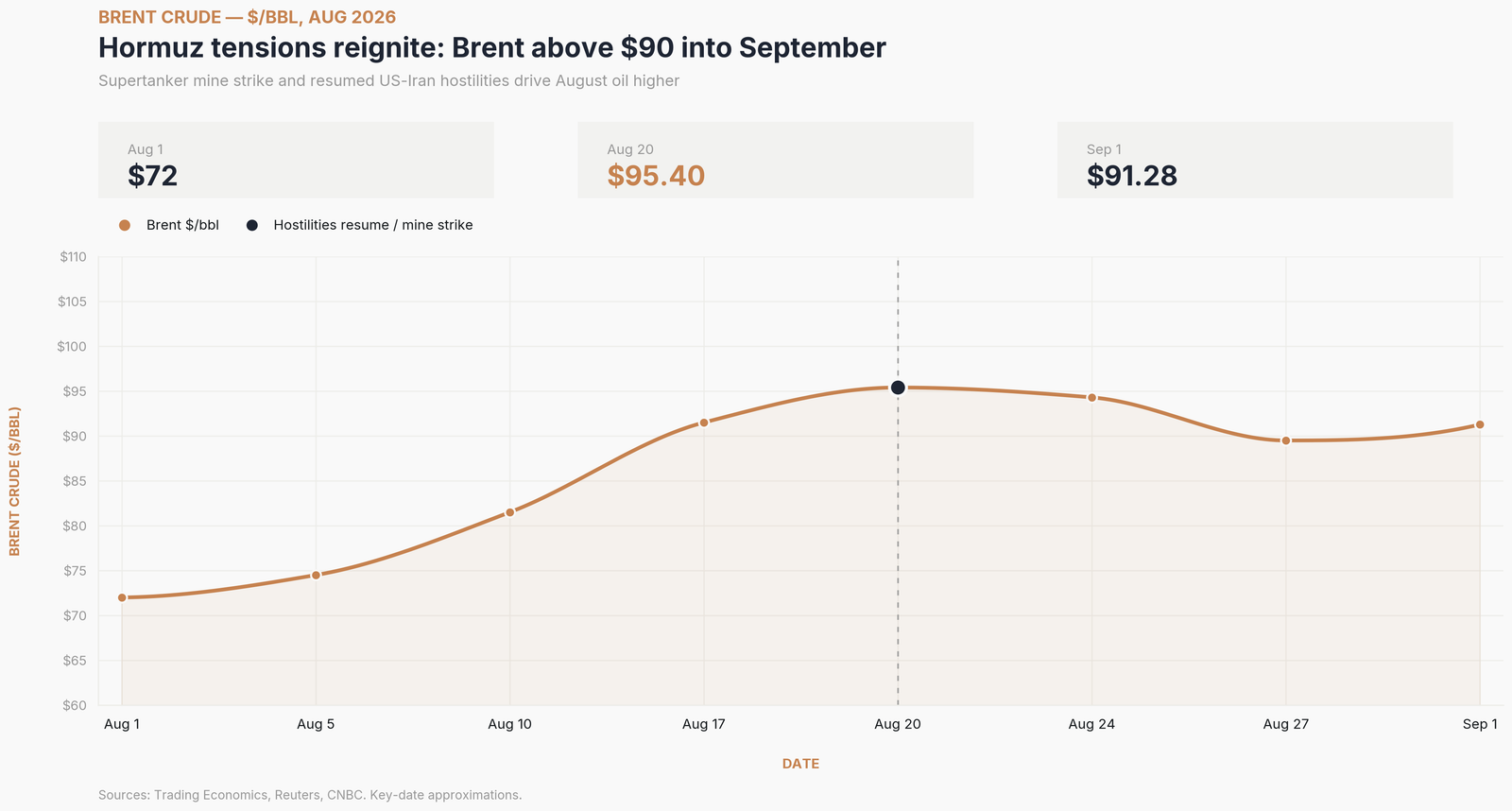
The structural point: the Strait of Hormuz has become a recurring, not exceptional, source of oil price volatility. An estimated 6 to 8 million barrels per day continue to transit the strait. The risk premium attached to that flow is now permanent, not temporary. For inflation, this is the mechanism by which Warsh’s Jackson Hole caution is validated: energy prices at $90–$95 create a fundamentally different CPI environment than energy at $72.
The midterm election incentive that has stabilised the diplomatic framework throughout the year remains in play. But the administration’s ability to manage both military operations and energy price diplomacy simultaneously is being tested.
Gold: The August Surge and What Comes Next
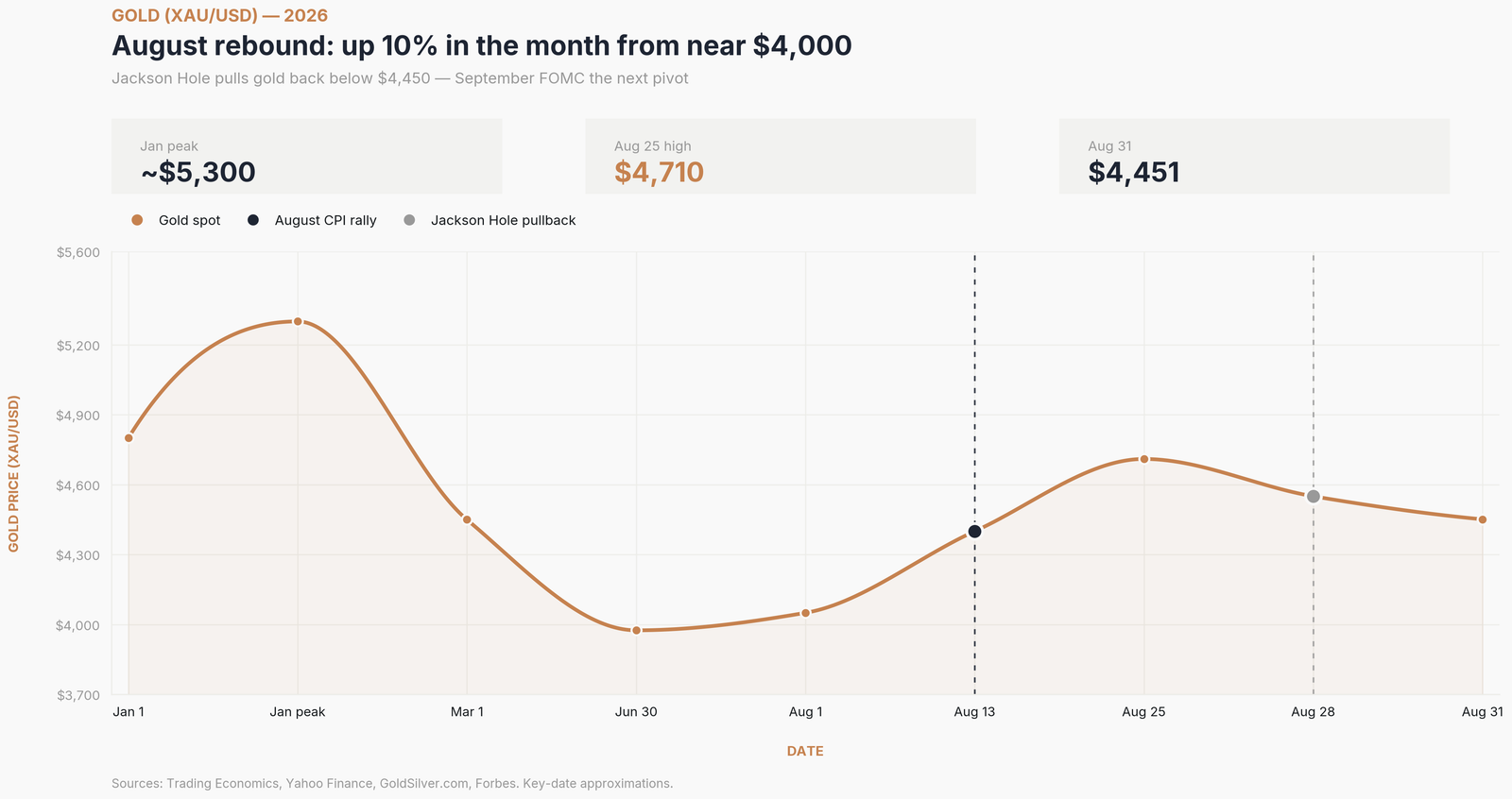
Gold entered August near $4,000 per ounce — its lowest level since November 2025. It exited near $4,450, having briefly touched $4,710 on 25 August. The month produced a 10% gain, the metal’s strongest monthly performance since January’s record run.
What Drove the Rally
What Jackson Hole Changed
The Structural Case Remains Intact
The near-term volatility does not alter the long-term picture:
Institutional targets: Goldman Sachs $4,900, J.P. Morgan $4,500 for Q4, Bank of America $4,360. All three remain above current prices. Any pullback toward $4,200 to $4,300 should be viewed as an accumulation opportunity, not a signal of structural deterioration.
Portfolio Framework for Q4 2026
The final quarter of 2026 opens with three forces in active tension: record earnings, hawkish monetary policy, and resurging energy risk. The investor who understands how these interact will be better positioned than the one who reacts to any one of them in isolation.
Let the Earnings Cycle Do Its Work
A market delivering 30% annual earnings growth does not need liquidity support to sustain itself. It can absorb a 25 basis-point rate hike because earnings are expanding faster than the cost of capital is rising. The Q3 and Q4 earnings seasons, guided at 27.4% and 25.2% growth respectively, are the primary tailwind for equities into year-end.
What this means in practice: maintain diversified equity exposure, favour breadth over concentration, and avoid making macro calls that override a strong earnings foundation.
Watch the September 10 CPI Print
The next decisive event for all asset classes is the August CPI release on 10 September — five days before the FOMC meeting.
Warsh has publicly committed his credibility to the inflation fight. A hot CPI print leaves him little room to stand down.
Oil Is the Inflation Wildcard
Brent above $90 is the mechanism that keeps inflation elevated and keeps the Fed hawkish. Every week of sustained energy prices above $90 increases the probability of a September hike and reduces the probability of a gold recovery.
The Strait of Hormuz risk premium is now structural. Portfolio exposure to real assets and energy infrastructure remains relevant not as a tactical trade but as a structural hedge against a risk that has been permanently repriced.
Income Generation in an Elevated-Rate Environment
Whether the Fed hikes in September or defers to December, rates will remain elevated for an extended period. Fixed income and private credit continue to offer real yields that did not exist three years ago.
Liquidity Remains Optionality
The events of August — a supertanker fire in the strait, a central bank pivot, a 10% gold rally in three weeks — are a reminder that dislocations arrive faster than most portfolios can respond to.
Liquidity is not underperformance in this environment. It is the capacity to act when others cannot.
Final Thought
August 2026 demonstrated something important: good data and good earnings are not sufficient to remove uncertainty from the investment landscape. They are necessary conditions for a healthy market. They are not sufficient conditions for a simple one.
The S&P 500 at record highs, a Federal Reserve chair who just told Jackson Hole that inflation has been above target for 65 consecutive months, oil that can move 30% in six weeks, and gold that can gain and lose 10% within a single month — this is not a market that rewards passive observation.
What it rewards is structure. Diversification across asset classes and return drivers. Income generation that compounds through volatility. Liquidity that converts dislocations into opportunities. And the discipline to let a 30% earnings growth cycle do its work without being distracted by the noise around it.
Commentary by AIX Investment Group
Disclaimer
The above market analysis/information is produced for information and knowledge purposes only under personal capacity, and does not constitute any liability or obligation upon the readers or the firm to take investment decisions. AIX Financial Consultation LLC is regulated by the Capital Market Authority (UAE), licence number 869463. Professional investors only.
References